

Why following Jesus was never meant to be a solo journey
There is a phrase I keep coming back to:
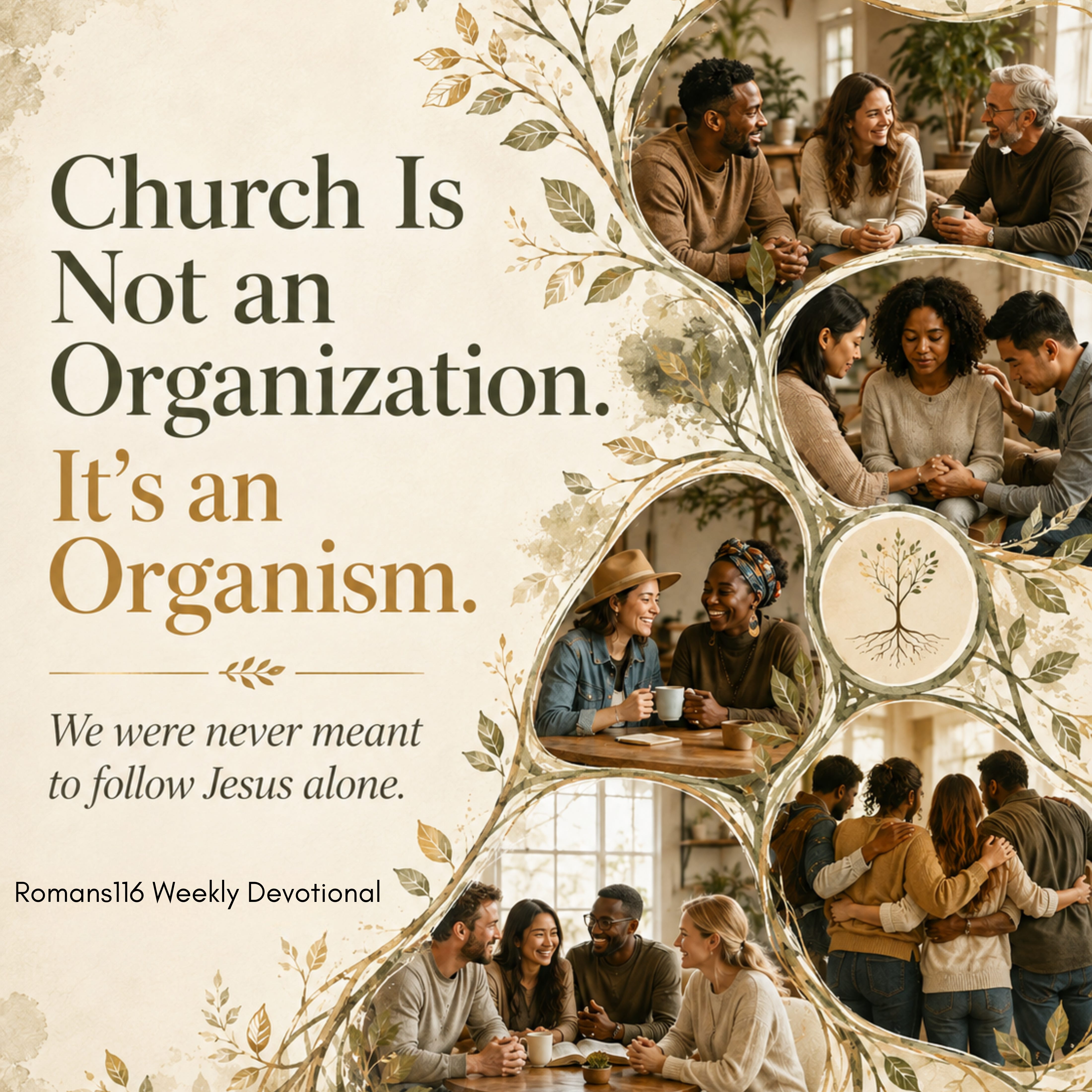
The Church is not an organization. It is an organism.
Organizations are built around systems, schedules, structures, and roles.
The Church may use all of those things, but that is not what makes it the Church.
The Church is alive.
It is made up of people who belong to Christ and, because they belong to Christ, also belong to one another.
Paul describes believers as a body.
“Now you are the body of Christ, and each one of you is a part of it.”
— 1 Corinthians 12:27
That image matters.
A body is not simply a collection of independent parts occupying the same space.
The hand needs the arm.
The eye needs the rest of the body.
The heart cannot decide it has a “personal relationship” with the body while separating itself from everything else.
Connection is part of how the body stays alive.
And yet sometimes Christians approach faith as though the ultimate goal is simply:
Me and Jesus.
Personal faith absolutely matters.
You need your own relationship with Christ.
You need your own prayer life.
You need to know Scripture for yourself.
You need to follow Jesus because you believe—not because your parents, pastor, spouse, or friends believe.
But a personal relationship with Jesus was never intended to become an isolated relationship.
Personal Does Not Mean Private
There is an important difference between something being personal and something being private.
Your relationship with Jesus is deeply personal.
But Christianity is not designed to be lived privately, disconnected from the people of God.
Jesus calls individuals.
Then He places those individuals into a family.
Paul writes:
“So in Christ we, though many, form one body, and each member belongs to all the others.”
— Romans 12:5
Notice that language.
We do not simply belong to Christ.
In Christ, we belong to one another.
That can feel uncomfortable in an age that prizes independence.
We like choosing when to connect.
We like relationships on our own terms.
We like the idea that no one should expect anything from us.
But biblical community asks more.
It asks us to be known.
To serve.
To forgive.
To encourage.
To carry burdens.
To receive correction.
To show up when someone else is struggling.
And sometimes—to let other people show up for us.
Look at All the “One Another” Verses
One of the clearest arguments against isolated Christianity is simply to notice how often the New Testament tells believers what to do for one another.
Love one another.
Serve one another.
Forgive one another.
Encourage one another.
Carry one another’s burdens.
Pray for one another.
Confess to one another.
Teach one another.
Admonish one another.
Honor one another.
Be patient with one another.
Accept one another.
Build one another up.
Live in harmony with one another.
Those commands are everywhere.
And every one of them assumes something important:
You are close enough to other believers to actually do them.
You cannot bear someone’s burden if you never know what they are carrying.
You cannot encourage someone you refuse to know.
You cannot practice forgiveness without relationships that occasionally become difficult.
You cannot serve one another from permanent isolation.
You cannot build up the body while remaining detached from it.
The sheer number of “one another” commands should tell us something about God’s design.
Christianity is relational by nature.
Church Is More Than Attending a Service
This is where we can misunderstand church.
Sometimes when we say “church,” we mean a building.
Or a Sunday service.
Or a denomination.
Or a staff.
Or an institution with a budget, website, programs, and calendar.
Those things may support the life of a church.
But none of them are the Church itself.
The Church is people.
Living stones.
Brothers and sisters.
A body.
A family.
A flock.
A people being formed together into the likeness of Christ.
Peter writes:
“You also, like living stones, are being built into a spiritual house.”
— 1 Peter 2:5
Living stones.
That is very different from an organization.
An organization can function efficiently while its people barely know one another.
A biblical church cannot fulfill its calling that way.
Because much of what God wants to accomplish in us happens through other people.
Sometimes God Uses People to Grow Us
That includes difficult people.
Church community would be much easier if everyone thought like us, voted like us, communicated like us, worshiped like us, and never offended us.
But then we would miss opportunities to grow.
Patience needs someone to be patient with.
Forgiveness requires something to forgive.
Humility develops when we realize our perspective is not the only one.
Service costs something because another person has a need.
Grace becomes real when relationships become imperfect.
That does not mean tolerating abuse, manipulation, or unhealthy leadership.
Healthy boundaries still matter.
Accountability matters.
Wisdom matters.
But avoiding all meaningful Christian community because people are imperfect creates another problem.
We remove ourselves from one of the primary environments God uses to shape us.
The Early Church Was Deeply Connected
When we look at the early believers, we do not see isolated Christians occasionally attending the same event.
We see shared life.
Acts tells us they devoted themselves to teaching, fellowship, breaking bread, and prayer.
They shared resources.
They ate together.
They prayed together.
They worshiped together.
They carried needs together.
They were deeply involved in one another’s lives.
Their faith was personal.
But it was unmistakably communal.
That is one reason the metaphor of an organism is so powerful.
Living things depend on connection.
Sever a branch from a tree long enough and it dies.
Separate a body part from the body and it cannot thrive.
God designed His people to grow together.
What If You’ve Been Hurt by Church?
For some people, this conversation is complicated.
Maybe your distance from church did not begin with laziness.
Maybe it began with pain.
Maybe someone betrayed your trust.
Maybe a leader abused authority.
Maybe you felt judged, ignored, controlled, or rejected.
Those wounds are real.
And returning to community may require time, wisdom, boundaries, and healing.
But the failure of people does not cancel God’s design.
The answer to unhealthy community is not necessarily no community.
Often, it is healthier community.
Safer leadership.
Better boundaries.
Greater discernment.
Relationships built slowly and honestly.
You do not have to trust everyone immediately.
But do not let someone else’s failure convince you that God intended you to walk alone.
Ask Yourself This
If most of your Christian life could continue exactly the same without another believer in it, something may be missing.
Because Scripture assumes relationships.
Who knows what you are struggling with?
Who can challenge you when you are drifting?
Who are you encouraging?
Whose burden are you helping carry?
Who are you praying for?
Who are you serving?
Who has permission to speak truth into your life?
And who can call you at 10:30 at night because life just fell apart?
That is church too.
Maybe more than we realize.
We Need One Another
The goal is not simply attending church more often.
The goal is belonging.
Being connected.
Participating.
Allowing yourself to be known.
Helping other people follow Jesus while allowing them to help you do the same.
Your relationship with Jesus is personal.
But it was never meant to terminate with you.
Christ draws us to Himself.
And then He draws us toward one another.
Because the Church is not merely an organization you attend.
It is an organism you belong to.
And every part matters.
Reflection Questions
Do you currently have meaningful Christian community, or mostly Christian proximity?
Who in your life truly knows how you are doing spiritually?
Which “one another” command is hardest for you to practice?
Have past hurts caused you to withdraw from relationships God may want to use in your healing?
What is one practical step you could take this week to become more connected to the body of Christ?
Closing Prayer
Father, thank You for calling me into relationship with You and into the family of believers. Forgive me for the times I have treated faith as something I can live entirely on my own. Help me value the body of Christ the way You do. Give me wisdom to build healthy relationships, humility to receive from others, and courage to serve, encourage, forgive, and love well. Heal any wounds that have made me afraid of community, and lead me toward people who will help me follow You more faithfully. Teach me to remember that I was never meant to walk this journey alone. In Jesus’ name, Amen.